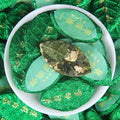
The Kunming Tea Factory is one of the pillars of the modern Chinese tea industry. The largest state-owned enterprise in the capital of Yunnan Province was the first to produce Pu-Erh tea on an industrial scale. Thanks to skilful management, the factory not only preserved the traditions of tea leaf processing, but also developed revolutionary new technologies that changed the perception of this unique beverage worldwide.
In this article, we present the history and development of the legendary Kunming Tea Factory, explain how to recognize genuine Pu-Erh tea, and describe its unique flavor characteristics.
From 1938 to today: The historical journey of the Kunming Tea Factory
The Kunming Tea Factory is rightly considered one of the most important symbols of the Chinese Pu-Erh tea industry. Founded in 1938/39 (originally under the name “Fu Xing”), it was the first company to combine the harvesting, processing, and blending of tea from the entire province of Yunnan. From the outset, the factory laid the foundation for the technological and taste standards that are now associated with classic Pu-Erh.
In its early years, the factory mainly produced Tuocha – compressed tea that was easy to transport and store. Due to its low production volume, it was subject to little government supervision. However, as early as 1954, the government required local traders to travel exclusively to designated areas for the procurement, transport, and wholesale of tea. State control over the procurement and distribution of raw materials gave large factories, including the Kunming factory, a significant advantage. During this period, the factory began to actively expand its production and build a reputation as one of the leading Pu-Erh producers. Even the difficult years of the “Great Leap Forward” in trade, marked by overproduction and scarce tea supplies, did not slow the company down: long-term stored tea leaf reserves were used to meet market obligations. This underscored the factory's strategic role in the industry. A real turning point came in the 1970s, when the factory finally came under the direct control of the Yunnan provincial government. Production lines were purchased, the product range was expanded, and new technological experiments were launched. For example, Kunming, together with the Menghai Tea Factory, played a key role in the development and implementation of accelerated fermentation technology—the process that brought the world ripe, aged Shu Pu'er. This fundamentally changed the market: tea that previously had to be aged for decades became accessible to a wider audience. As a result, these new developments led to a rapid increase in exports. In the mid-1980s, the Kunming Tea Factory supplied over a thousand tons of tea annually, covering up to 80% of the Pu-Erh market in Hong Kong and Macau. To handle these volumes, a separate factory and a large logistics and storage complex were built in 1985. The institutional role of the Kunming Tea Factory was no less significant. In 1986, with its participation, the Provincial Quality Supervision Bureau, responsible for evaluating tea products throughout Yunnan, was re-established. Thus, the Kunming factory influenced not only taste standards but also the development of the quality system throughout the industry.
In 1996, the factory closed in its traditional form, but that was not the end of its history. Its reopening in 2006 under new management restored the continuity of classic recipes and production methods. Today, the factory covers around 20,000 square meters and produces over a thousand tons of tea annually, which is sold both domestically and for export.
Yunnan Pu-Erh tea is easy to recognize: a deep dark infusion with earthy and woody aromas created by perfect fermentation and maturation. These characteristics have made it a sought-after item among collectors and connoisseurs of traditional Pu'er tea.
The 1973 revolution: How the “Wo Dui” process changed Pu-Erh
Until the early 1970s, tea was available exclusively in the form of Sheng – “raw” Pu'er – whose aroma only developed after decades of natural maturation. High humidity, slow microbiological processes, and time were essential components of this maturation process. This tea was highly prized by connoisseurs, but remained difficult to obtain: not everyone could afford to wait years for the leaves to develop their soft yet full aroma.
A turning point came in 1973 with the invention of Shu Pu-Erh, which is now rightly considered a milestone in the history of Pu'er. At that time, specialists at the Kunming Tea Factory, based on the practice of long-term tea storage in Guangdong and Hong Kong, succeeded in translating their individual expertise into a technology that could be applied on a large scale. This marked the birth of the Wo Dui fermentation process – wet storage – which marked the beginning of Shou Pu-Erh tea.
The essence of this method was to create artificially controlled conditions that accelerated natural fermentation. The raw materials for Mao Cha were piled up in heaps up to 70 centimeters high, evenly moistened, and covered with cloths. A unique microclimate developed in these piles: the increased humidity and warmth promoted the growth of microorganisms, especially Aspergillus fungi. Within a few weeks – usually 45 to 60 days – the tea underwent a process that had previously taken decades.
The result was astonishing. The tart, spicy green leaf was transformed into a dark, full-bodied, and smooth tea with a pleasant, slightly sweet, earthy flavor, without the strong bitterness of young Sheng. For the first time, Pu'er became not only a collector's item, but also a tea for everyday enjoyment.
The significance of this technological revolution can hardly be overestimated. The Kunming Tea Factory was the first company in history to mass-produce Shu Pu'er, revolutionizing the entire industry. Pu'er became a rapidly produced product with a huge market. In recognition of this contribution, the Kunming factory was awarded first place in the official China Tea Standard register in 1973.
Pu-Erh Collection

Sale price
€14,9070g
€180,00 / kg


Sale price
€42,90100g
€360,00 / kg

Sale price
€35,90100g
€300,00 / kg

Sale price
€68,58260g
€220,00 / kg

Sale price
€29,90100g
€250,00 / kg


Sale price
€11,9050g
€200,00 / kg


Sale price
€8,9060g
€120,00 / kg


Sale price
€7,9040g
€160,00 / kg

Sale price
€7,9025g
€260,00 / kg


Sale price
€25,9080g
€270,00 / kg

Sale price
€17,9060g
€250,00 / kg


Sale price
€12,905g
€2.190,00 / kg

Sale price
€12,9050g
€210,00 / kg

Sale price
€14,905g
€2.530,00 / kg


Sale price
€33,90100g
€280,00 / kg

Sale price
€15,905g
€2.700,00 / kg

Sale price
€40,90100g
€340,00 / kg

Sale price
€33,90100g
€280,00 / kg

Sale price
€16,9060g
€230,00 / kg

Sale price
€20,9060g
€290,00 / kg

Sale price
€62,70280g
€180,00 / kg

Sale price
€63,80200g
€260,00 / kg
CNNP and the “Zhong Cha” logo: How to recognize genuine Kunming tea
One of the most famous and frequently copied symbols in Chinese tea production is the Zhong Cha (CNNP) brand — China National Native Produce & Animal By-Products. It consists of eight red characters for “Zhong” (China) surrounding a central green character for “Cha” (tea).
This symbol encodes the tea producer and is decoded using special keys. To distinguish genuine tea products from the Kunming factory from those of other Chinese producers under the auspices of CNNP, several criteria must be taken into account:
The number “1”: According to the 1976 recipe system, the last (fourth) digit of the four-digit code on the label always indicates the producer. The Kunming factory is coded with the number “1,” as is the legendary 7581 brick tea.
The Jixing label: During the restructuring of the factory (1996–2006), when the main brand name was no longer used, the Kunming company produced tea under the Jixing brand. So if this word appears on the packaging, it is most likely authentic Kunming tea.
Unique packaging. Original Kunming tea bricks labeled 7581, produced in the 1990s, were wrapped in porous paper and feature a distinctive font that is difficult to imitate in today's artisanal production.
Flavor profile: What makes Kunming teas so special?
Kunming tea is easily recognizable by its distinctive characteristics, which are influenced not only by its technology but also by its place of cultivation. In the world of Pu'er tea production, where each large brewery is associated with its own style, the Kunming tea factory occupies a special position. While Pu'er from the Menghai Tea Factory is traditionally prized for its dense creaminess and Xiaguan for its characteristic smoky notes, Kunming is considered the benchmark for purity, subtle sweetness, and lightness of flavor. Kunming is the capital of Yunnan and a unique tea center in the province. Historically, raw materials from various regions flowed here, and the highland climate and dry storage conditions shaped a unique maturation process. One of the most distinctive features of Kunming Shu Pu'er is its so-called “date aroma” – Zao Xiang. This is particularly evident in classic recipes, such as the tea block marked 7581. Moderate fermentation reveals notes of dried dates, raisins, and warm dried fruits without tasting earthy or overly sweet. This flavor profile is perceived as pure and without unnecessary nuances.
As it matures, the flavor becomes more complex. Mature Pu-Erh teas develop woody and camphor-like notes – the aroma of old wood, dry bark, and a slight coolness reminiscent of incense – a sign of high-quality raw materials and careful maturation.
Experts often highlight the Kunming factory's principled approach to fermentation. Traditionally, it takes a “middle” approach: the tea is not brought to maximum maturity during production. This preserves the so-called “vitality” of Pu-Erh – its ability to change and develop over time. Unlike heavily fermented Shu Pu-Erh teas, Kunming teas continue to mature over many years. Storage conditions also play an important role. Kunming's cool, dry climate ensures slow, gentle maturation without off-flavors or excess moisture. This is particularly appreciated in Sheng Pu-Erh teas: over the years, they lose their tart bitterness and become milder, while still retaining the original flavor profile of the raw material.
Conclusion: A piece of tea history in your cup
The history of the Kunming Tea Factory is essentially the history of the development of Pu-Erh tea, which evolved from a regional product to a globally popular tea. Here, a new strategy for producing aged Pu-Erh tea was developed that revolutionized the entire industry.
Kunming Pu-Erh is valued in many countries around the world for its high-quality raw materials from the Chinese highlands, its gentle fermentation, and its pleasant, full flavor that develops over time. This soothing beverage is suitable both as an introduction to the world of Chinese green teas and for everyday tea enjoyment.
Our tea shop ARTEAMONY offers a wide selection of original Pu-Erh teas from the Kunming tea factory. We have something for every taste – from inexpensive classics for everyday enjoyment to matured collector's teas.